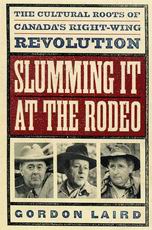
Slumming It At the Rodeo
The Cultural Roots of Canada's Right-Wing Revolution
Laird, Gordon
Publisher: Douglas & McIntyre, Canada
Year Published: 1998
Pages: 208pp Price: $19.95 ISBN: 1-55054-627-9
Library of Congress Number: FC635.L34 1998 Dewey: 971.064'8
Resource Type: Book
Cx Number: CX6867
Are the Federal Reform Party's Manning, Ontario's Harris and Alberta's Klein the struttin' cowboy champions of direct democracy? Or just sell- outs to the private sector? Laird tackles these questions.
Abstract:
-
Table of Contents
Preface
Cowboys and Indians
Attention Shoppers: From Nation-State to Mega-Mall
Aggressive Civilization: Assimilation for the Nation
The Spiritual History of Debt: True Believers Face the Apocalypse, Again
The Politics of Opportunity
The Cost-Cutting Cowboys: Outlaws on the Margins of Democracy
The World Is My Franchise: Fast-Food Politics From Head Office
Homesick on the Range: Strong Citizens and Family Values
The Next Horizon
Democracyland: Where Voters Are Tourists
Back to Nature: New Age Capitalism and Global Prophecy
Take Control: From Rodeo to Status Quo
Afterword
Notes
Bibliography
Index
Excerpts:
"I personally believe that most criminals are cowards who prefer to prey upon the weak and defenceless of our society," argued [Reform MP Darrel] Stinson in 1997, oblivious to the irony of his party's own appetite for minority - and poor - bashing.
No amount of flashy grievance-mongering against Big Government is going to cover up the fundamental contradictions of neo-conservativism: regimes that promise both democracy and discipline; tributes to freedom and individual spirit from political control freaks; a creeping disdain for democracy itself; and an appetite for quick-fix solutions and Promised Land happy endings.
Despite the absence of populist substance, there is still plenty of scheming..... Harper noted in a 1989 memo that Reform's success depended on reaching out to the disaffected middle class of Canada's cities and suburbs. To achieve national cross-over, the party would have to "emphasize moderate, conservative social values consistent with the traditional family, the market economy, and patriotism."
It's a war of position, to borrow a phrase from Italian Marxist Antonio Gramsci: the masking of differences and difficult issues in an effort to corral maximum voter support.
But there is no escaping the cultural convergence of the entertainment industry and politics; they both share low regard for their audiences - people who were, at one time, considered genuine participants.
The product itself is often all but forgotten in the effort to sell intangibles like freedom, adventure and happiness. Against the humble backdrop of rural populism, Reform has built its own deluxe brand name on a series of lifestyle statements (heterosexual family), consumer desire (debt-free prosperity) and cowboy flattery (you are strong, you are independent...)
Politics must be forcefully brought to market with the sole purpose of creating a new "climate of opinion," a strategy not to be confused with revitalizing democratic processes. "You've got to be putting forward [your] viewpoint in every single debate...," said Thatcher, "and hopefully having all of the people who believe the same way also making speeches, also writing to the press, also trying to create the climate of opinion to enable those principles to be turned into practice... You must in your own non-political way, endeavour to make your principles the issues of national debate."
In addition to fuelling the general fires of debt anxiety, the CSR cornered the electoral market on three hot-button issues: tax cuts, workfare and affirmative action....
In fact, the CSR marshalled every fancy marketing bell and whistle it could afford, including an interactive 1-800 telephone line and 2.5 million copies of its platform booklet, The Common Sense Revolution. The campaign platform itself appeared more than a year in advance of the election, having been the subject of an equally lengthy period of "sophisticated market research."
"You can't mix your message. The power of advertising is that you've got to be repetitive, you've got to really saturate your message, because that's the only way it's going to get across in all the clutter." Leslie Noble, Mike Harris's campaign co-chair, 1995
[The anti intellectual impulse] is also evidence of the advanced degree to which modern party politics are scripted. Franchise politics means you know how to follow the instructions from head office; it doesn't mean you actually have to know anything. "Sometimes too much knowledge is a dangerous thing," said Harris, in defence of his cabinet.
Language is one of the final frontiers of right-wing populism. Saddled with a membership prone to discriminatory statements, the Reform Party has embraced doublespeak and euphemism, the bane of the straight-shooting populist. From its constant efforts at damage control, the party has become proficient at saying one thing and meaning another.... The most interesting development in this pragmatic (if not completely unconscious) employment of post-modernism is Reform's colonization of liberal-democratic language: equality, justice, democracy. Properly spin doctored, appropriated words like "equality" can make assaults on social programs, native rights and immigration seem almost palatable.
There is a fundamental conflict in all this fundamentalism. "Why ... are economic actors 'necessarily other-regarding'?" asked political scientist Trevor Harrison. Why should possessive individualists care a fig about anything other than themselves.
There is a profound moral crisis at the heart of neo-conservatism, in Canada and elsewhere. Their open economic range is woefully empty of public spirit. In their ideal world, human dependency and social responsibility have been privatized; the family is the only place where greed does not rule supreme.
By limiting an election campaign to a few hot-button issues, today's political maverick can drag public discourse down into the gutter with little effort. "Because the press couldn't take any of [the] free market changes that Harris was proposing seriously, they didn't subject him to the same kind of scrutiny that they would have otherwise," observed Conrad Winn, chair of Ottawa's Compass Research.
Subject Headings
