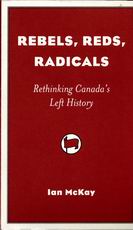
Rebels, Reds, Radicals
Rethinking Canada's Left History
McKay, Ian
Publisher: Between the Lines, Canada
Year Published: 2005
Pages: 254pp ISBN: 978-896357-97-3
Library of Congress Number: HX109.M35 2005 Dewey: 335'.00971
Resource Type: Book
Cx Number: CX8105
McKay looks at the history of the left in Canada as a series of experiments in "living otherwise" -- efforts to work out ways of life and thought strategically opposed to the prevailing liberal-capitalist order.
Abstract:
Ian Mckay starts his book with an analysis of what we mean by the "left". He defines the left broadly to include anyone who understands the injustice of capitalism, the possibilty of democratic alternatives and the need for social transformation. He offers a historical approach based on the work of Antonio Gramsci -- an approach he terms "reconnaissance". This would allow leftists to speak to one another across the many dialects of leftism that constitute our traditions. It would allow the left to encompass a greater diversity of people: religious and cultural figures, First Nations, visible minorities, feminists, environmentalists and Quebec nationalists amongst others. McKay writes with those who have struggled for a better world and invites us to go forward to make this a reality - the possiibility of a post-liberal, post-capitalist democratic society.
Table of Contents
Realms of Freedom, Realms of Necessity
Redefining the Left
Liberal Order and the Shaping of Resistance
The Strategy of Reconnaissance
Mapping the Canadian Movement
Notes
Index
Excerpts:
If you start to think of Marx not as three or four set-in-stone theories, but as a dynamic and changing cultural code, which has interacted differently with the societies it has encountered over time, you start to see Marx more as a process than as a simple set of texts. Since the actual writer's death in 1883, the term Marx has referred not just to his writings ( many of which were not generally accessible until the 1970s), not just to his political program -but also to the complicated and surprising ways in which this time-release capsule has interacted with succeeding generations
One way of getting to know something about our present possibilities is to develop a better understanding of how people in the past tried to construct and extend their own realms of freedom. What worked? What failed? What lives on? Meaningful answers to questions like that need more patience and time than either left-wing or right-wing sectarians generally allow. My sense of how to reach accurate and politically interesting answers from the history of the left is that we need to sit down and listen as attentively as we can to the leftists of the past , struggling with all our might to place their work in context. We need to balance our sympathy with their ends with a frank critique of many of their means.
The Manifesto maintained that socialism is not just an ideal but something actually emerging, a "set of objective possibilities," in the actual social and economic world around us.
Once a group, usually closely tied to a class achieves hegemony, it works to make its historical choices- for instance, constructing a liberal order-seem to be just like natural phenomena, to which no sensible person can object. The language of the hegemonic group comes to seem like an ordinary, common-sense way of describing reality. You almost have to shake yourself to realize that, step by step, you have been drawn into a language game crafted for specific purposes that you actually have no real interest in serving.
Right-wing politicians of Bush's ilk succeed primarily because they create a political language that many people, workers included, strongly identify with.
In a fundamental sense, there is a human need to belong and to knit together in communities and societies. Churches and community choirs, charities and sports events, service clubs and folk festivals all suggest this enduring need for community- a need that acquisitive individualism cannot satisfy. Yet this search for community takes place in a context of intensifying atomization.... By and large, as impressively documented empirical studies confirm, advanced consumerist materialism erodes, rather than satisfies, a sense of well-being.
The Gramscian point is not that defiance of this vast alienating world is futile. It is that resistance is both necessary and difficult. To make any lasting difference, resistance can be neither merely individual nor narrowly class-defined. To become genuinely effective, acts of opposition must engage with the underlying economic and social processes that structure the entire system. If, like much middle-class cultural work today, acts of resistance come from a space of alienated and angry fatalism, they simply ratify the impression that there is nothing worthwhile or permanent to be done. They add their little bit to an ambient sense of futility.
Each "utopian projection from the left has transformed the world-never nearly as much as its militants had hoped, but often far more than the liberal order had been initially prepared to concede. The partial achievement of democracy and civil liberties we enjoy today would not have happened without, and is now only really understood and defended by, the activists of the left.
We have to imagine generations of radicals past and generations yet to come as our co-investigators and co-activists- not as people standing before us at the bar of history, awaiting out God-like judgment. In our present politics we have to go beyond our immediate interests to create ways of linking up with people who can become political allies, without sacrificing Marx's core insights into the fundamental contradictions of the system
[C]haracteristically, radical formations in Canada change overtime. They start off by borrowing massively from other countries. Their heroes, pivotal texts, big debates are all imported. Then, after a decade or so, as a cohort grows into its time and place, the formation changes. It starts to generate interesting idiosyncrasies that set it apart on the world stage.
A particular leftism can work to provide its devotees with a "filter" of specialized words and images so thick that nothing from the external world can raise any profound questions about its conceptual system's fruitfulness as a guide to social reality. Such purity comes at a cost. If all room is eliminated for any test of key representations against the goal of realizing a realm of freedom, the formation has started to become a historical artifact rather than a history making force. It has started speaking only to itself, defending a set of doctrines that forbid any questions. It is on the road to a cult-like irrelevance.
There are sound reasons why those who pretend to "speak for" minorities to which they do not belong have been warned against trespassing and appropriation of voice. It is presumptuous of men to speak of women, of tenured professors to speak of industrial workers, or of women to speak of gay men, if doing so implies an implied right either to "speak for" the interests of the other or to intuit and then write authoritatively about his or her heartfelt experiences. Reconnaissance makes no claims to speak on behalf of the people it describes and contextualizes. This is not its province.( When, as is necessarily sometimes the case, it deduces consciousness from behaviour, it must proceed with utmost caution.) A mission of reconnaissance is inherently an exercise in trespassing-breaking boundaries and developing in-depth knowledge of hidden terrain- for the purpose of contributing to a more general understanding.
Subject Headings
