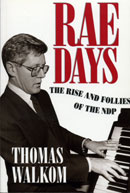
Rae Days
The Rise and Follies of the NDP
Walkom, Thomas
Publisher: Key Porter, Toronto, Canada
Year Published: 1994
Pages: 296 Price: $18.95 ISBN: 1-55013-683-6
Resource Type: Book
Cx Number: CX6516
An account of Bob Rae's New Democratic Party government in Ontario.
Abstract:
-
Table of Contents
1 The New Democrats
2 A Liberal in Sandals
3 Party Animals
4 Wackos from Outer Space
5 Revenge of the Pink Ladies
6 The Casino Economy I : Not Much Coherent Thinking
7 The Casino Economy II: Pink Floyd Meets the Debt Wall
8 With Friends Like These..
9 Taking Care of Business
10 A Nation's Greatness
11 Same Boat Now
12 No Sex Please, We're New Democrats
13 Mo of the Jungle: On and Off the Privatization Bandwagon
14 That Was Then: This Is Now
Notes
Index
Excerpts:
Indeed, the NDP was able to put into place more of its agenda in two short years than ever before. Ironically, the NDP also put more of its agenda into place with the Liberals governing than it did later during its own time in power.
There were only two institutions which the new government could have used to control the agenda of government -- the cabinet office and the premier's office. The former is made up of career civil servants, the latter of partisan political aides. Canadian precedents existed for using either.
To keep both minister and bureaucrats in line, key aides were hired centrally and dispatched to ministerial offices. The idea here was to emulate the NDP's election-campaign structure, one in which candidates did not choose their campaign managers but were assigned them by party headquarters. In elections, this allowed the NDP's central organization to ensure that its candidates didn't do anything too nutty. The hope was that a cadre of experienced aides working with inexperienced ministers could perform the same service for the government.
"There was hope for change and a willingness to work with the NDP, which the NDP tragically failed to work with or understand," one senior civil servant said later. "There was an expectation that this government would be sympathetic to government programs. We were disabused of that very rapidly."
In the mid-1980s, the Bank of Canada could use inflation as an excuse to put downward pressure on wages, as it raised interest rates, and thus unemployment. By the early 1990s, when inflation was effectively licked, the federal government could then turn around and use public debt as an excuse to continue the same kinds of wage-squeezing policies.
The result was the worst of all worlds -- a budget Keynesian enough to anger business but not stimulative enough to do much good. After tax increases and previously announced programs were counted in, the budget called for about $350 million in net new spending on a budget of $53 billion -- enough to spark only about 15,000 new jobs in the economy. In a province where 250,000 jobs had been lost over the past year, this was small beer.
The final passage of labour-law amendments marked a watershed. They had been conceived in the earliest days of government, when the NDP was still relatively feisty, willing to challenge the conventional wisdom of business and the right. By January 1, 1993, when the amendments become law, the Rae government had become fully converted to the same conventional wisdom. The arguments that corporate lobbies had made in opposing the labour-law amendments -- that at a time of recession anything that interferes with business confidence is counter-productive -- was now being used by the government itself. Bill 40 would remain an anomaly. It would mark one of the few times the government didn't cave in to business.
It was a crafty bill which allowed negotiations to continue until the beginning of August but left virtually nothing to negotiate. Unions that agreed to enter the social contract voluntarily would be rewarded with access to an unemployment-insurance top-up fund. Those that did not agree would be denied access to this fund, and would be punished with a larger wage roll-back.
Even the satisfaction of direct refusal was denied. In a particularly Orwellian bit of doublespeak, the act permitted the government to declare an agreement reached in any sector of the public service even if no one except the government agreed.
Indeed, the drug companies had hit the NDP government at one of its most vulnerable spots, its vanity. Because of their experience with the labour movement, Rae and some of those around him thought of themselves as shrewd, hard-nosed negotiators. Compared with the drug multinationals, however, they were babies.
In October 1990, Ontario, Ottawa, and the Canadian Auto Workers signed a generous deal with Varity Corp., successor to the troubled farm-machinery giant Massey-Ferguson. The deal permitted Varity, on payment of $50 million, to move out of Ontario and escape prior commitments to employ Canadians. It also cancelled the $200-million debt which Varity would otherwise have owed Ottawa and Ontario.
What the government did not seem to appreciate, however, was that by means of this deal it had given the doctors, through their trade union, a veto over almost $4-billion worth of government's annual spending... A government which would have balked at giving teachers a veto over education spending or trash collectors one over environmental spending had no compunction about giving this kind of power to the doctors.
Over its term, the government would take the initiative in a few significant areas... Significantly, most of these were areas in which the NDP in opposition, or at least activist groups associated with the party, were committed and had laid the groundwork.
As well, some were uneasy about the NDP's decision to concentrate so narrowly on race. "It's too narrow and sterile a thing to live and breathe," said one black activist working closely with the secretariat. "Because this race thing doesn't seem to allow for any other aspects of analysis. It's an unreal construct, sterile... Unless you bring some sort of political analysis -- some sort of class analysis -- into your analysis to do this work, you have difficulties."
Subject Headings
